
Breaking Down the Biggest Problem with Branding: ROI
Issue #0003

Dear Brand Owner,
I have an undying love for Suits. The TV series, I mean. I quite fancy the attire too, but certain concepts in the drama seem to resonate with me to my bones and draw me back to it.
A unique character, to be precise.
A little fun fact about me: I am a bit of a cinephile. I have seen my fair share of cinema. And when I say “fair share”, I am merely trying to bury the enormousness of my knowledge of cinema in a handful of modesty. Given that outrageous confidence is one of the easiest ways of portraying pure masculinity and aura on screen, I have been exposed to quite a number of characters with that trait in my cinephile career. Cooper’s docking from Interstellar, Jon Snow at the Battle of Bastards, Klaus Mikaelson in the Vampires of New Orleans scene, ‘My name is Maximus Decimus Meridius’, Achilles from Troy, Tyler Durden from, well, I am not allowed to talk about it. I need not go on.
But despite being continuously exposed to confidence from its most calm to its most reckless, one particular character still has me awestruck with just how different he is.
Harvey.
Specter.
He doesn’t fight in unwinnable battles like Jon Snow, nor does he try to dock a thousand-ton spacecraft onto a spinning windmill five times its size in the oblivion of space like Cooper. He is a lawyer. A highly revered and feared one.
Harvey is the most narcissistic, egotistical character TV has ever managed to convince us was a good guy. Following Marty Supreme, of course. I wouldn’t dare rob him here, too.
Forgive me. Cinema can have me easily distracted.
Now what is it about Harvey Specter and his ego, that I couldn’t fully express with a million words on these pages, that is so deeply ingrained with brand equity?
Harvey, in all his brilliance, feeds off one fundamental bias. I mentioned this bias in last week’s piece on how your customers make their decisions, and you should read it if you haven’t. It holds a lot of gems.
The bias is called the halo effect. It is quite simple. It means we do not evaluate things in isolation but as a whole. As a result, one strong encounter with an idea, a person or a venture bleeds into everything else, and vice versa. This is why attractive people are often assumed to be intelligent or competent even though there is no logical connection between the two. Once a frame of excellence or incompetence is set, you view everything else through that picture. Which is why I concluded in last week’s piece that your best marketing investment is a satisfied customer. Because they set the frame for everyone else they talk about your business to.
Now let us quickly run through the components of Harvey’s halo.
Jessica Pearson: For the uninitiated, Jessica is Harvey’s boss, mentor and biggest advocate. She paid for him through law school. And even though he didn’t graduate at the top of his class, not even second or third, every time Harvey walks into a room she says: “This is Harvey Specter, the best closer in this city.” You have never met Harvey. You have never even heard of him. But Jessica Pearson, the head of one of the biggest law firms in New York City, just told you he is the best. Even if he doesn’t immediately look the part, you believe her. And from that moment, you begin to view everything he does through one lens: he knows exactly what he is doing.
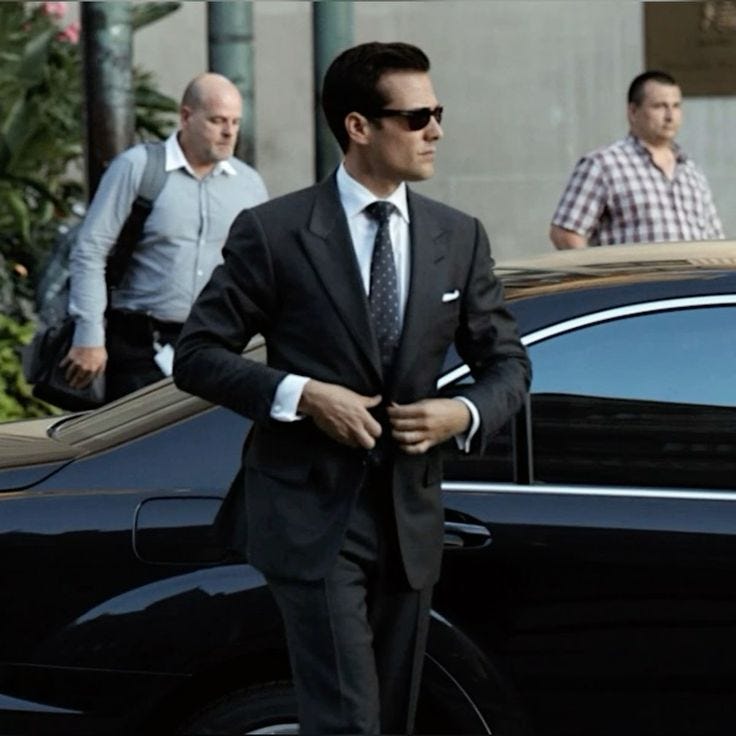
The suits: The second most important component of Harvey’s halo is his appearance. Yes, he has just been hyped up to you. But if he walked in wearing a baggy T-shirt and tight jeans, there might still be room to doubt. Harvey always shows up as a well-groomed, six-foot man in a ten-thousand-dollar suit, strolling in casually like he owns the firm. He hasn’t uttered a single word. But the frame you are forming is already one of unquestionable competence.
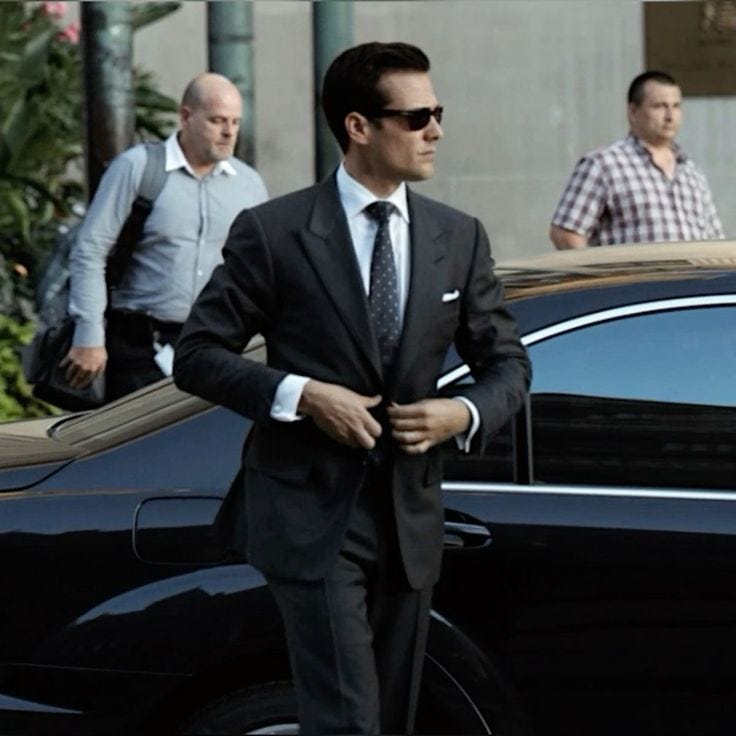
His confidence: Harvey does not doubt himself. At all. Ever. The way he stares, walks and talks communicates a certainty that is almost contagious. As a client, you are convinced you are in the right place before he has done anything to prove it.
Harvey: Winners don’t make excuses.
Ross: Michael Jordan told you that?
Harvey: No, I told him.
You don’t hear someone talk like that and question them.
We haven’t even gotten to his skills as a lawyer. But every single first encounter you could have with Harvey is carefully curated to communicate competence. And the impact of this on his success is vastly understated.
Don’t believe for a second it is unintentional. Harvey himself tried to make sure Ross understood this clearly: competence alone is not enough. The appearance of competence is equally important.
There was a scene where Harvey took Ross to a casino in Los Angeles. Ross feared he wouldn’t be let in because he had been banned in a previous life for counting cards. Back then he used to show up in T-shirts and jeans.
Harvey dressed him in an expensive tuxedo, arrived in a limousine and strolled in. They were welcomed with glasses of champagne by two women at the entrance.
“Did you used to get this kind of service when you came here in jeans?” Harvey asked.
The lesson was clear.
Now the percentage of Harvey’s success accounted for by the halo he built is very difficult to put into numbers. And that, ladies and gentlemen, is the biggest problem with branding. We often cannot quantify the return on investment. Only that it is necessary, vastly helpful and that the alternative can cause damage hitherto unheard of.
And here is where most business owners make the critical mistake. Because they cannot put a clean number on what their brand is doing, they assume it isn’t doing much. They treat design as decoration. They treat brand identity as a luxury they will invest in later, after the revenue comes in. They don’t understand that the brand is what makes the revenue come in.
The market has repeatedly, and painfully, proven them wrong.
In 2010, Gap unveiled a new logo. They had been using their iconic blue box logo for more than twenty years. It was recognizable, trusted and deeply embedded in the identity of millions of loyal customers. The new logo was a clean, corporate wordmark that looked like it belonged on a generic spreadsheet template. The public reaction was immediate and brutal. Customers took to social media with a fury that Gap’s leadership hadn’t anticipated. Within six days, Gap scrapped the redesign entirely and returned to the original logo. The damage to brand perception, to customer trust and to the PR cost of reversing a decision that publicly the brand had believed in, was significant. All of it from a logo change.
In 2013, Tropicana repackaged their orange juice. They removed the iconic image of an orange with a straw stuck in it, which had been their visual identity for years, and replaced it with a generic, minimalist carton design. Sales dropped by twenty percent within two months. Twenty percent. That is not a small fluctuation. That is the market sending an unambiguous message: we trusted what we knew. You changed it and we don’t recognize you anymore. Tropicana lost approximately thirty million dollars in sales in those two months before pulling the redesign and returning to the original packaging.

In Nigeria, the conversation is closer to home than most people want to admit. I once asked a friend why he preferred Jumia to Konga. He didn’t talk about product selection or delivery speed. He said: “Have you ever visited both websites? Look at the design. Look at how fast one loads compared to the other. Then you’ll understand.” He was not describing the product. He was describing the experience of encountering two brands and how that experience shaped an assumption of competence that the products themselves never had to earn separately.
This is the halo effect in the real world of commerce. And it works both ways with the same force.
The brands that invest in coherent, intentional design are not spending money on aesthetics. They are buying trust they would otherwise have to earn through hundreds of individual interactions. They are creating the conditions under which their product gets evaluated fairly, through a lens already primed to believe in the quality behind it. Every naira spent on building a brand that communicates excellence is a naira spent making every subsequent sale easier.
The brands that ignore this are not saving money. They are accumulating a perception debt that compounds quietly in the background. Every time a potential customer encounters a pixelated logo, a slow website, an inconsistent social media presence or a brand that simply looks like nobody made a decision about it, a verdict is filed. And that verdict travels. It shapes referrals. It influences the conversations your customers have about you in rooms you will never enter. It determines whether your product gets a fair hearing or arrives already doubted.
Competence alone is not enough. The appearance of competence is equally important.
Harvey Specter understood something that most business owners spend years learning the hard way. Competence alone is not enough. The appearance of competence is equally important.
Business owners assume once they have a quality product, everything else will take care of itself. But don’t forget there is literally a guy who is just as competent as Harvey Spectre but doesn’t get his flowers because he doesn’t have Harvey’s halo. It was consistently stated that Louis Litt’s billables beat Harvey's every single day, but it’s generally assumed that Harvey is a better lawyer and more important to the firm.
This happens partly because the world is shallow. But, more importantly, because trust is the currency every transaction is denominated in. And trust is formed in the first encounter, through how your brand communicates before you have said a single word, before you have demonstrated a single thing, before your product has had a single chance to speak for itself.
Brand aesthetics are not superficial. Every first encounter your audience has with your business is an opportunity to set a frame. A frame of excellence or a frame of doubt. And once that frame is set, everything that follows gets filtered through it. Everything.
From your logo to your design to your customer service to the way your emails are written to the speed at which your website loads. Leave nothing to chance.
Because the market is making judgments about your business right now. In silence. Without telling you. And those judgments are either compounding in your favor or quietly working against everything you are trying to build.
Design the first impression deliberately.
The halo it creates will do work you cannot do yourself.
If this piece made you think differently about something, there is probably someone in your orbit it would do the same for. Forward it to them. Better yet, send them this link and tell them to subscribe before the next one drops.
And if you have thoughts, pushback or something this sparked in you, I want to hear it. Reply directly. I read everything.
See you next week.